Thursday, December 18, 2014

Pdf Tricks on Arch

Here're some more arch tips and tricks so I don't forget them.

Merge Pdfs into one big Pdf:

Using ghostscript this is pretty easy (ghostscript is part of a standard Tex install):

$gs -dBATCH -dNOPAUSE -q -sDEVICE=pdfwrite -sOutputFile=file.pdf Input1.pdf Input2.pdf Input3.pdf

Problems, the metadata for the new file will be that of the last file, if this needs to be changed there's a way.

Changing Metadata for Pdf's on Arch Linux

Using exiftool this isn't too bad, bugs with paths associated with exiftool seem to have been fixed, and it's in the official repository (perl-image-exiftool).

$exiftool -Title="Title" -Author="Author" -Subject="Subject" file.pdf

Note that this creates a new file called file_original.pdf, which is surprisingly enough the original file. The modified version will be file.pdf.

Also for information on which tags are present use:

$exiftool file.pdf

Monday, June 2, 2014

10 foot Strides


Here're some photos from my first day with my new toy. I ordered a nimbus nightfox 36 in hopes of doing some unicycle touring on it this summer, specifically the goal is a 100 mile one day ride out to the boiling river in Yellowstone.

Some initial thoughts:
  • It starts, stops, and turns slower than a 24. Specifically the stopping was a bit surprising.
  • The top speed on the outer hole of the cranks seems to be about 10 miles an hour. Perfect for touring (I hope.)
  • The handlebars make a world of difference. I rode 25 miles without them and was pretty sore, with them on it feels like you could ride forever.
  • Disc brakes are different to set up. I'm going to swing by Altercycles this afternoon and get some help tweaking them.
  • People still love a guy on a unicycle. My first stoplight experience ended with me landing on the hood of a Subaru (hopping is different). The owner's reaction was "I love your unicycle".


Wednesday, May 28, 2014

Video from Saint George


Here's some video of the "Barrel Roll" trail in St. George. The rider is Rees, a math student at Dixie.


Tuesday, February 4, 2014

Lick Creek

Some scenery shots from skiing up Lick Creek on Sunday. This short little meadow is a great deal of fun and is pretty free of avalanche hazards (~30 degrees). East aspect and knee deep powder made for some great runs.


Friday, January 17, 2014

include{} and input{} in Latex

This is just a quick note on the differences between the commands include{} and input{} in Latex. Both of them have essentially the same function: read some tex from a separate file to make writing large documents easier in Latex. There are some key differences.

Note: 
  • with my setup neither command will work unless you leave off the .tex extension.
  • include{} has a \clearpage before and after it.

include{} is best used to include something like a chapter. In other words the file should be almost all of a stand alone document. It shouldn't include a \begin{document} or an \end{document}, headers, footers, or package inclusions. It should be noted that commands which have filepaths in them are referenced from the location of the file being executed, not the included file.

input{} is best utilized for importing the enormous list of \usepackage and custom commands that everyone seems to have at the top of their tex documents.

For example we might have a file system which looks like this:
  • example.tex
  • Images
    • exampleimage.png
  • Chapter1
    • chapter1.tex
  • Preamble
    • preamble.tex
example.tex

\input{Preamble/preamble}
\begin{document}
This is my example document...
\include{Chapter1/chapter1}
\end{document}

preamble.tex

\documentclass[a4paper,11pt]{article}
\usepackage[utf8]{inputenc}
\usepackage{default}
\usepackage{amssymb}
\usepackage{graphicx}

chapter1.tex

\section{Chapter One}
This is the first chapter...\\
Here's a picture:\\
\includegraphics{Images/exampleimage.png}

Which generates this pdf.

Wednesday, January 15, 2014

Shishikura's Lemma 3

In keeping with Sam's demand for more nerdy code, I've decided to provide a chunk of my thesis for the perusal of randoms from the internet. This link leads to a short paper I've written detailing the proof of a result I need for my result. The result itself is Lemma 3 found in the perturbation section of a paper called 'On the Quasiconformal Surgery of Rational Functions' by Mitsuhiro Shishikura.

The cones in the sketch correspond to the striped regions in this picture. The green circles are level curves in Siegel disk. Exactly which functions can give rise to such a disk is the topic of my research.


Friday, January 10, 2014

EBGBs

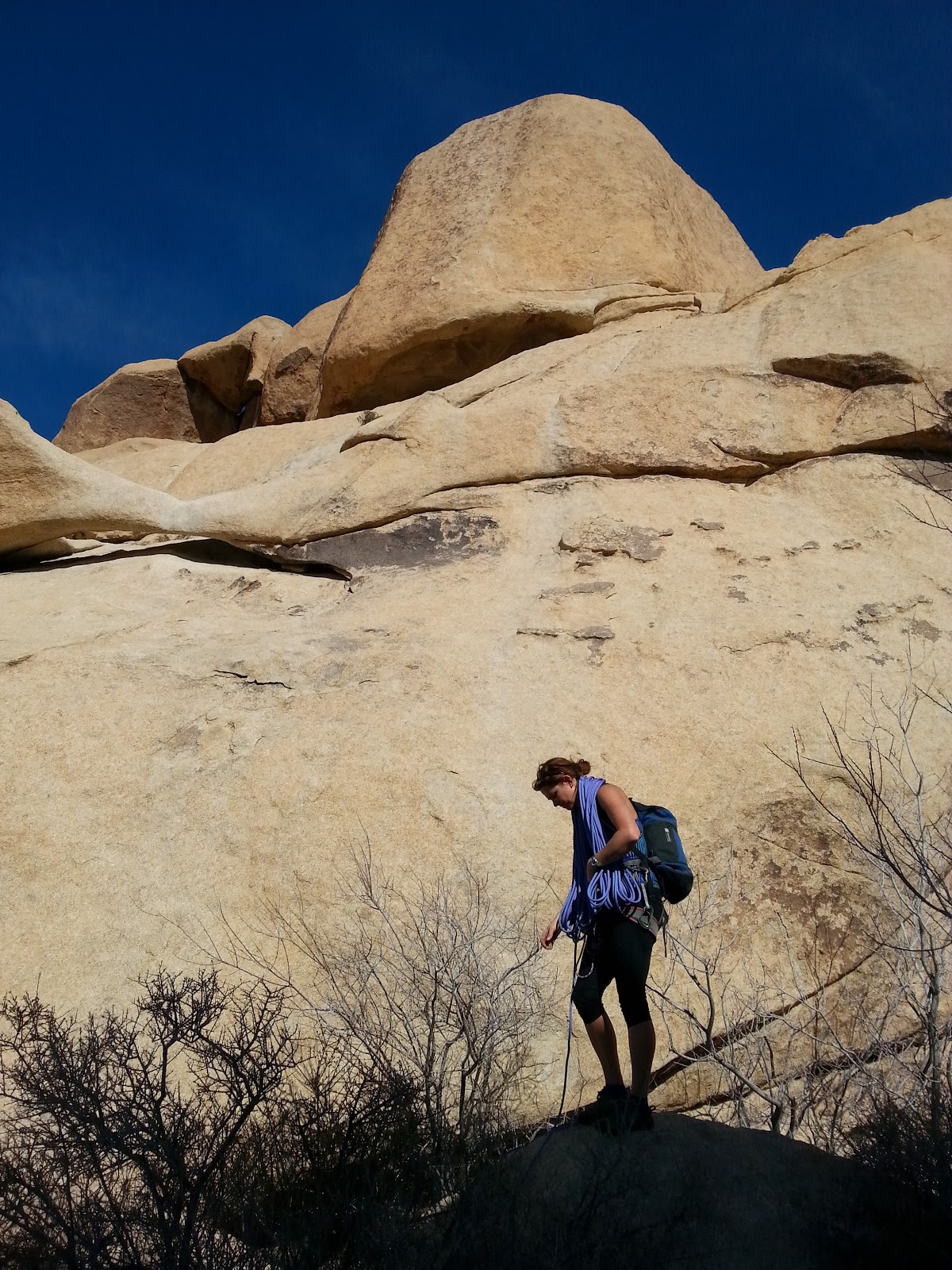
EBGBs is legend, it's bold and beautiful, an old classic. The kind of thing found in only a few places in the world, the mark of an era when men were men and rock climbing was dangerous. It's a bolted trad climb, when it was first done it may have been one of the very hardest routes climbed.

It sits on a block above the Echo area in Joshua Tree, daring everyone who sees it to climb it. I've wanted to climb it for ten years, since the first time I read about it in Lynn Hill's book. Now I can definitively say one thing:

EBGBs is a vision quest.

While I was 20 feet above my last bolt at the very top of the slab I had an experience. I had a conversation in my head for the first time on a route, it went something like this:
  • 'My hand is slipping, I'm going to be falling now.'
  • 'That's going to fucking hurt, don't.'


EBGBs is on the front of the big block above Leigh.


This is the opening 'ledge', you mantle onto this sucker. It seems scary, but that's only because you'll take a nasty little swinging fall into a wall. In the end it's not bad.


Note the position of the last bolt, a good 20 feet down the face.


I only got this one picture of me on it, hanging off the anchor glad to be alive.


Tuesday, December 3, 2013

Yet Another Day at the Office

10 inches of fresh powder made this morning's ride into a real workout, with lots of falls and desperate saves I think I earned my whiskey tonight.

Monday, December 2, 2013

Just Another Day at the Office.

Here're some pictures from today's commute. It was super nice at 7:30, hence the completely inappropriate dress.

Wednesday, November 6, 2013

Two Days at the Dregs

Day One:
Henry asked me to go check out his project up at the Dregs, he said he'd bolted a pretty and hard arete. Given the fact that almost every 'arete' in Bozeman is more of a rounded prow I was pretty skeptical. It turns out that I was wrong to doubt Henry's assessment, he bolted what must be one of the sharpest overhanging aretes I've ever seen.
The Incisor as seen from the trail. It's the downhill side of that big hanging block behind the tree.

This is the stellar view from the main wall of climbs at the Dregs, unlike other areas in Gallatin Canyon there's almost no river or car noise up here.
Henry just after whipping from his day one high point.

The Incisor Arete is brutally hard, with a crux only 20ft tall it's amazing how full body tired you get trying it. Your hands are tired of pinching and crimping, your forearms and biceps are burning from long moves and slaps on small holds, your legs are shaking from trying to wrap the arete with your left thigh while standing on it with your right foot, and your mind is whimpering that the whole thing is going to fall over like a giant cleaver.


Day Two:
Yesterday when Henry suggested we go back up to the Incisor I was pretty sure we'd end up freezing our butts off at the cave instead. Fortunately more psyched heads prevailed and we ended up hiking up and having a great session.
 The stick was a life saver on the S2 approach, although crampons would have been better.
Henry forgot his harness so he climbed all day in this full body maternity harness.
 Here's the traverse over from the base of the main wall to 'Count Dracula', which is both the warm-up and has the rappel anchor to get down to the Incisor. 
Here's Henry belaying me over to the base of the Count, note the obligatory hip belay, because if you're short roping snowy traverses gri-gris are bad form. There aren't any pictures after this (cold fingers), but we both had a couple good burns at the Incisor. Henry was able to make another high point and then surpass it. He was essentially through the crux, so I'm sure he's hoping for a day just a couple degrees warmer for the send. I managed all the moves, now I'll have to start giving it redpoint burns. We're both thinking it's someplace near 13b. I'm a bit out of shape, but it seems to be quite a bit harder than Hantavirus at the cave.

Monday, November 4, 2013

LaTeX DynaLite

I'm giving a DynaLite on the very useful LaTeX typesetting language later today, so I thought I'd put my talk here so that anyone who wanted it could see it. It should be noted that the header in the talk is not the whole header I used in the tex file, but I think the only missing items are the Beamer theme information.

Here's the pdf.

Here's the tex file.

Tuesday, October 29, 2013

Lattès Example

I gave a DynaLite on the Lattès example last week and given the shortage of information on the web I'm posting my notes. This is a more algebraic geometry perspective than those offered in Beardon and Carleson/Gamelin, it somewhat follows insight from Milnor. Here are my notes which are somewhat out of order, and here is a helpful picture of a torus generated with the following tikz code. The clip function is really handy, and you can put things outside the clipped box by just inserting the code for them prior to the clip command.

\begin{tikzpicture}[scale=1.5]
      %Clip
      \clip (-3,-3) rectangle (3,3);
      
      %Horizontals
      \foreach \x in {-2,-1,...,2}
 \draw[-] (3.000000,\x) -- (-3.000000,\x);
    
      %Slants slope = .61825
      \foreach \x in {-5,-4,...,5}
 \draw[-] (2+\x,2*1.61825) -- (-2+\x,2*-1.61825);
 
      %Fills
      \fill[green!20!white] (0,0) -- (1,0) --   (1.61825,1) --(.61825,1) --cycle;
      \fill[blue!20!white] (0,0) -- (-1,0) --   (-1.61825,-1) --(-.61825,-1) --cycle;


      %axis
      \draw[<->][red] (3,0) -- (-3,0);
      \draw[<->][red] (0,3) -- (0,-3);

\end{tikzpicture}

Monday, October 28, 2013

Diophantine Numbers

I spent a while today writing up this little primer on Diophantine numbers. It's mostly the coverage Milnor gives in chapter 11 of Dynamics in One Complex Variable, but I've added some details and included the solution to 11-a.

It's probably riddled with typos and logical errors, feel free to correct in the comments.

Friday, September 27, 2013

Trickzy Tikz

So I wanted to make a regular 30-gon in tikz, but was way too lazy to work out the coordinates for each vertex on my own, so here's what I came up with:

Write a file called regpoly.c containing

#include <math.h>
#include <stdio.h>

int main(int argc, char *argv[])
{
int i=0;
double r=2;
double n= 30;
for (i = 0; i < n; i++) {
  printf("\\draw[-] (%f,%f) -- (%f,%f);\n",r * cos(2 * M_PI * i / n), r * sin(2 * M_PI * i / n), r * cos(2 * M_PI * (i+1)/ n), r * sin(2 * M_PI * (i+1)/ n));
}
return 0;
}

compile it in the terminal by typing

cc regpoly.c -o regpoly -lm

run it by typing

./regpoly

Copy the resulting output into a tikzpicture in latex. Clearly one can change the number of sides the gon has by replacing 30 in line 8. Note that wordwrap has made line 10 into two lines here, it needs to be only one for it to run.


Wednesday, September 18, 2013

R make command not found linux

I'm posting this because I've just found the solution to a really silly little issue basically without the help of any of the online discussions I was able to find.

The issue was installing the 'vegan' package in R on Arch Linux. All the errors are versions of

make: command not found

This is of course appearing because you don't have the 'make' command installed, so the R package 'vegan' and it's prerequisite 'rgl' won't work without it. To fix this you need to type the following:

pacman -S base-devel
pacman -S gcc
pacman -S gcc-fortran

The make command for bash is in the base-devel group, the one for C+ is in gcc, and the one for fortran is in gcc-fortran.